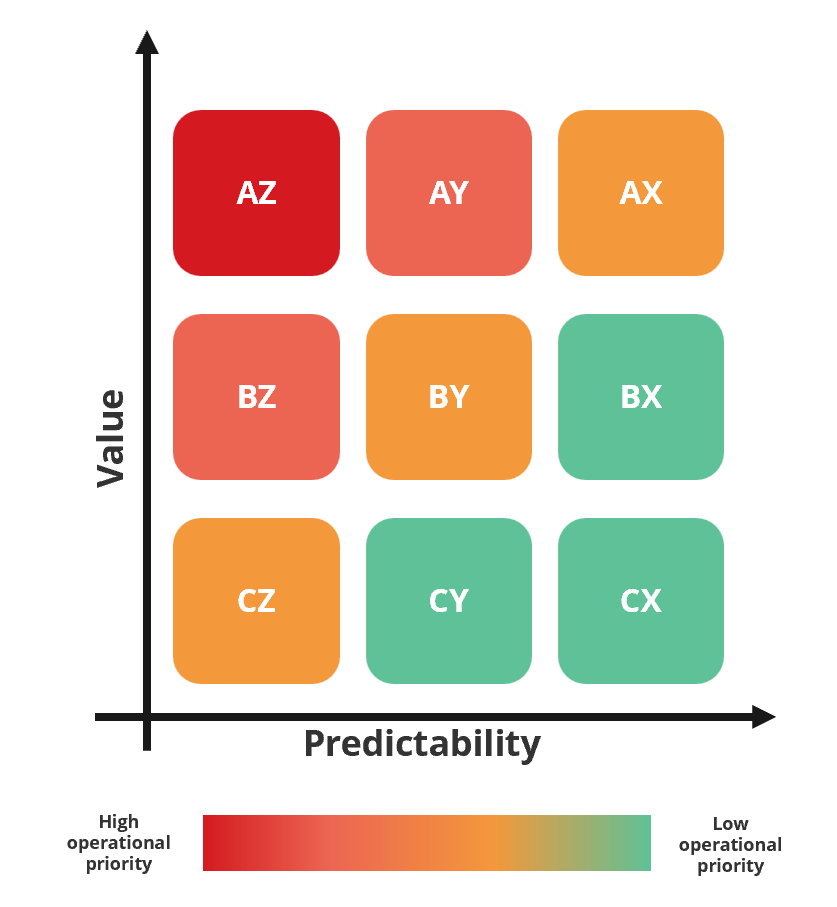
For years, ABC/XYZ has been among the most widely used analytical frameworks in supply chain management.
With the rise of more advanced optimization tools, some now consider these approaches outdated. The reality is more nuanced.
ABC/XYZ remains a powerful framework for understanding the main characteristics of demand, prioritizing attention, and aligning teams. However, when used as the primary engine for setting stock rules, it becomes too simplistic given the actual complexity of modern supply chains.
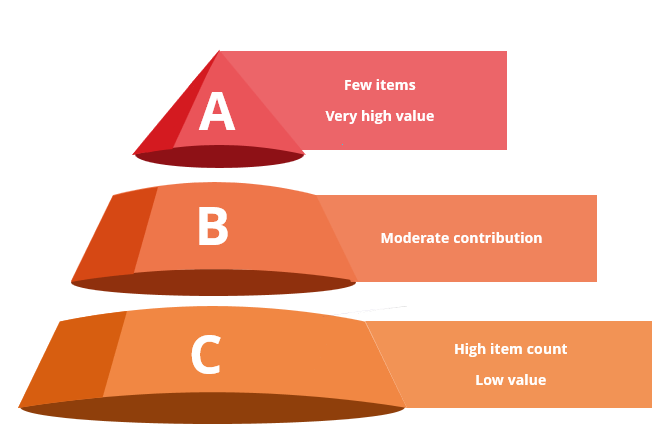
ABC is based on the Pareto principle: a minority of products accounts for the majority of business value.
In most companies, a small share of the portfolio (often 10 to 20% of the products) generates the largest share of revenue, margin, or total cost. A items account for this contribution, B products represent an intermediate contribution, and C products are numerous but with a low individual contribution.
The objective of ABC is therefore to identify where the economic impact of the portfolio is actually concentrated.
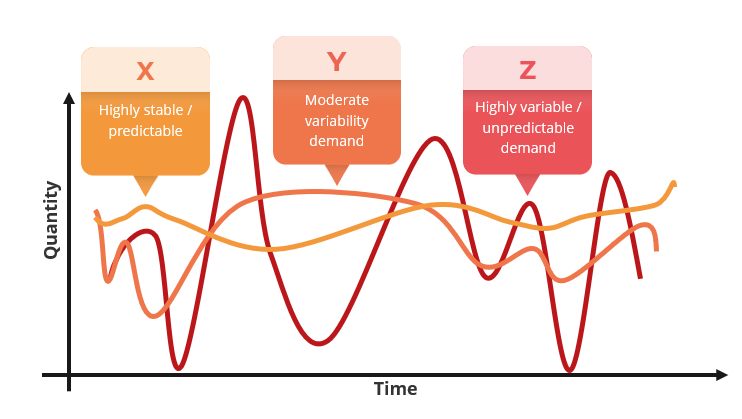
XYZ segments products according to the level of variability (or predictability when possible) of their demand.
Thus, X corresponds to stable and predictable demand, Y to more variable demand, and Z to erratic, intermittent, or difficult-to-model demand.
This dimension is essential because two products of equal importance to the company may be very different in terms of planning difficulty.
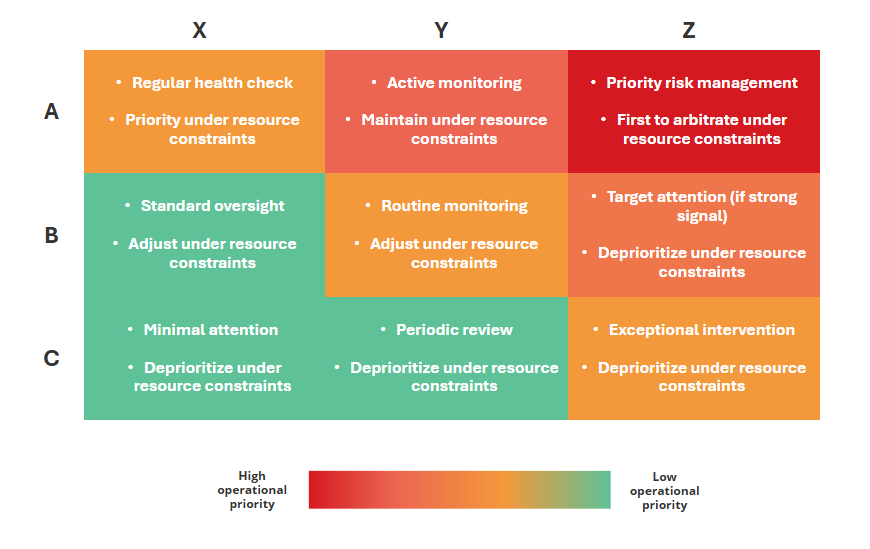
As forecasting and planning models are increasingly becoming “black boxes” and are proposing ever more difficult solutions to explain, ABC/XYZ remains a common language for all functions within the supply chain.
ABC/XYZ helps quickly identify which products must be secured as a priority to protect revenue and customer relationships. It also prevents comitting to the same level of service for all products, by taking into account differences in demand and supply constraints.
ABC/XYZ segmentation helps identify where reductions can be made safely and where stock plays a strategic role, for example in securing key revenues, strategic customers, or at-risk supplies.
ABC/XYZ helps to structure the prioritization of attention in complex portfolios. In reality, analysis time is always limited, for example in S&OP meetings. Segmentation then allows to focus the discussion on the products that have the greatest impact for the company, rather than trying to analyse the entire portfolio with the same level of detail.
It does not replace product-level analysis, but makes it possible to organise the effort where it creates the most value, while accepting a higher level of risk on less critical segments.
During crises, ABC/XYZ primarily becomes a quick decision-support tool for decision-making when time and information are limited.
In a liquidity crisis, it enables quick identification of which products to protect as a priority, rather than reducing orders uniformly. Conversely, in the event of a demand shock or hypergrowth, it helps to rapidly secure the products that are truly critical for the business.
In these contexts, ABC/XYZ accelerates alignment between finance, sales and operations by providing a simple framework for prioritising trade-offs.
Situation | Question | Contribution of ABC/XYZ | Roles concerned |
Customer service prioritization | For which products would a stockout have a direct impact on customer relations? | Enables identification of products that are critical for revenue and strategic customers | KAM, Customer service, Management |
Customer promises | Why can we not offer the same level of service for all products? | Highlights structural differences in demand and supply constraints | KAM, Demand planners, Senior Management, S&OP Analyst |
Arbitration of stock levels | Where can stock be reduced without risk of major impact for the company? | Distinguishes strategic stock from stock that can be optimized | Finance, S&OP, Management |
Capital tie-up | Which stock actually protects the value of the company? | Directly links stock, commercial risk and economic contribution | Finance, Management |
Prioritization in S&OP meeting | On which products should we spend the most time analyzing? | Enables concentration of analytical effort where the business impact is highest | S&OP, Management, Demand planner |
Very broad portfolio | What level of detail for which references? | Structures the analytical effort and allows greater risk-taking on less critical segments | S&OP, Planning |
Liquidity crisis | Which products must be protected as a priority? | Avoids uniform reductions and protects critical revenues | Management, Finance, S&OP |
Demand shock | Where should supply be secured as a priority? | Identifies the products for which a stockout would have the greatest impact for the company | Management, S&OP, Procurement |
Rapid decisions under uncertainty | Where to accept more risk and where to secure more? | Provides a quick view of value vs. risk | Management, S&OP, Finance |
ABC/XYZ becomes problematic when it is used to directly control stock levels rather than as an analysis tool. The risk emerges when analytical classes are translated into uniform operational rules, for example by setting an identical service level, coverage level, safety stock or rotation target for all products in the same class.
Indeed, products within the same ABC/XYZ class can have very different constraints, making uniform stock rules unreliable.
Moreover, since stock requirements are continuous and thresholds are arbitrary, ABC/XYZ is mainly used to understand and prioritize, not to directly set stock rules.
ABC/XYZ mainly describes the economic contribution of products and the general behavior of their demand. However, stock decisions also depend on many other operational drivers, such as lead times, supplier reliability, minimum order quantities, product shelf life, storage cost, margin, substitution options, and even commercial strategy.
In practice, this means that a product that is very important in terms of demand or revenue can be difficult to secure from a supply perspective, for example due to an unstable supplier or very long lead times. Conversely, a product with a low economic contribution may be simple, inexpensive and low-risk to stock. Relying solely on ABC/XYZ means ignoring an essential part of operational reality.
Thus, two products belonging to the same class can have very different constraints. They may share a similar economic contribution or a comparable level of variability, while having different realities in terms of procurement, storage, or substitutability. Applying a uniform stock rule then often leads to overstocking certain products and understocking others, which degrades both the service level and the efficiency of the capital employed.
The thresholds between classes are inherently arbitrary. Two very similar products may end up in different classes simply because they fall just above or just below a threshold, and be subject to varying stock rules even though their actual needs are almost identical.
In reality, stock requirements follow a continuous logic rather than a tiered one. Turning analytical classes into rigid operational rules therefore creates artificial discontinuities in stock management.
This often leads to overstocking certain products and understocking others. Overall, this can increase total stock while degrading the service level, because resources are not allocated where they actually create value. ABC/XYZ therefore remains very useful for understanding and prioritizing, but much less so for directly defining stock rules.
Today, modern tools make it possible to optimize stock decisions product by product. Machine learning and advanced time-series models tend to greatly improve forecast quality, for example by better capturing seasonality, promotional effects, the impact of weather, market trends, or certain external events.
In parallel, inventory optimization techniques simplify the determination of optimal service levels and stock levels by arbitrating between the cost of inventory and the cost of stockouts. These approaches take into account the actual variability of demand, lead times, minimum order quantities, production constraints, supplier risks, and even product substitutability.
In certain cases, advanced simulations also make it possible to better represent uncertain environments, such as unstable lead times, intermittent demand, or fragile supply chains.
These calculations can be recalculated continuously in order to adapt to changes in the market, demand, and supply.
In this context, the right approach is to optimize decisions product by product, then to use ABC/XYZ as an analytical tool to understand the results, explain trade-offs, and prioritize human intervention.
Once the role of ABC/XYZ has been clarified and its limitations understood, the challenge is to configure it in such a way that it is genuinely useful for business decisions.
A robust approach consists of building the ABC based on demand in value (units × price or cost, depending on the objective). This approach, used at Pawa, better reflects real economic impact than simply using volume, which tends to over-prioritize items with a very limited impact in terms of value.
For example, a low-price bottled water may generate very high sales volumes but a limited contribution in value or margin. Conversely, a product such as premium coffee capsules may sell in smaller quantities while representing a significant contribution to revenue.
The coefficient of variation of demand is useful in contexts with little seasonality.
However, a significant seasonality can distort the categories.
Indeed, highly seasonal demand may exhibit strong statistical variability while remaining very predictable from one year to the next. The coefficient of variation will capture the amplitude of fluctuations, but not their repetitive nature nor their actual predictability.
For example, sales of sunscreen may be highly concentrated in summer and almost zero in winter, which creates strong statistical variability, but with a very stable pattern and therefore relatively predictable from one year to the next. Conversely, a product such as bottled water may appear to have fairly stable demand over the year, yet become difficult to forecast because it is strongly influenced by external factors such as heat waves, alerts about water quality, or occasional precautionary purchases.
In such contexts, it is often more relevant to assess the ability to forecast demand based on forecast accuracy metrics rather than on the raw variability of demand.
New products cannot be properly classified in ABC/XYZ.
Good practices include:
temporarily isolating them
using analogous products / product families
Thresholds should not be treated as universal truths.
A 80/15/5 or 70/20/10 ratio can be highly relevant… or completely useless depending on the portfolio.
Good practices:
check the actual distribution of value before setting the thresholds
avoid forcing a fixed number of products per class if the business reality is highly concentrated
accept that some companies have very few A items and a very large number of C items
The objective is to have classes that are useful for discussions related to demand planning.